



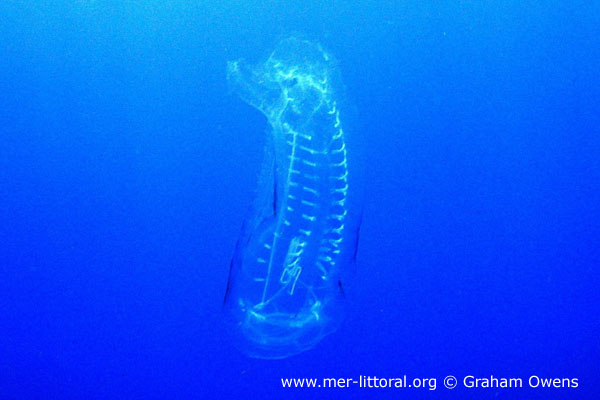
Port Cros, France, 20 meters, 2011, PS
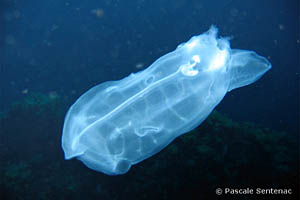
Tenerife, Espagne, 20 meters, 2011, GO
Source : World Register of Marine Species
Biota (Superdomain)
Animalia (Kingdom)
Chordata (Phylum)
Tunicata (Subphylum)
Thaliacea (Class)
Salpida (Order)
Salpidae (Family)
Salpinae (Subfamily)
Thetys (Genus)
Thetys vagina (Species)
Text : © 2006 - 2026.
Photos : ©
Pascale Sentenac, Graham Owens. Published with their kind permission.
Websites and reference works : Consult bibliography
Image satellite: © Esri, DigitalGlobe, GeoEye, Earthstar Geographics, CNES/Airbus DS, USDA, USGS, AeroGRID, IGN, and the GIS User Community.
Données de distribution : Thetys vagina Tilesius, 1802 in GBIF Secretariat (2019). GBIF Backbone Taxonomy. Checklist dataset https://doi.org/10.15468/39omei accessed via GBIF.org on 2026-06-09.
Source : World Register of Marine Species
Biota (Superdomain)
Animalia (Kingdom)
Chordata (Phylum)
Tunicata (Subphylum)
Thaliacea (Class)
Salpida (Order)
Salpidae (Family)
Salpinae (Subfamily)
Thetys (Genus)
Thetys vagina (Species)
Text : © 2006 - 2026.
Photos : ©
Pascale Sentenac, Graham Owens. Published with their kind permission.
Websites and reference works : Consult bibliography
En cours de rédaction, January 2006, Description of Thetys vagina, [On line] https://www.european-marine-life.org/32/thetys-vagina.php, consulted on 2026 June 09.
Author

Association pour la découverte et la protection du milieu marin
© Mer et littoral 2004-2026 - All rights reserved
The texts and images on this website are not free of rights and cannot be copied and/or used without the agreement of their respective authors.
 Print
Print Download