



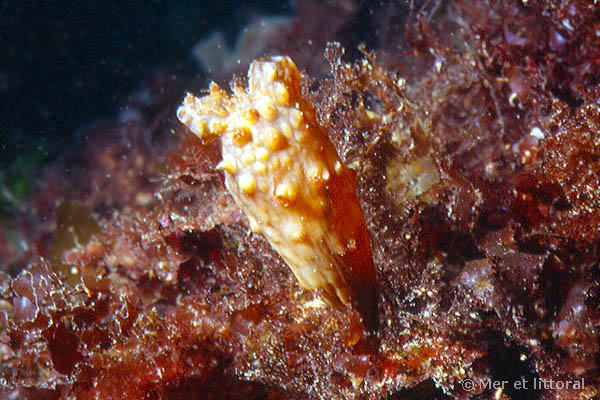
Rade de Brest, France, 8 meters, 2011, WBN
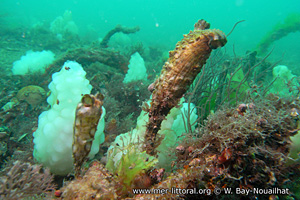
Concarneau Bay, France, 6 meters, 2011, WBN
Styela clava is a solitary ascidian of up to 12 cm high. It is club-shaped erected from a narrow stalk attached to the sustratum. The stalk size may be a third of the overall ascidian. The test is firm, leathery and wrinkled. Its colour is brown with white mottlings. Sometimes, algae or some invertebrates may fix and grow on it. The terminal siphons are close to each other. It lives in shallow water where water is warmer, in harbours, on piles, hulls or rocks and stones.
Styela clava first appeared in the English Channel, in Plymouth in 1953 and quickly spread through the North Sea, the Baltic Sea and through the Atlantic Ocean toward Spain. Originated from North-Western Pacific, Japan and Korea, it was probably introduced in Europe during the Korean War attached to battleship-hulls. Since 1981, it was also described on the other side of the Atlantic.
Source : World Register of Marine Species
Biota (Superdomain)
Animalia (Kingdom)
Chordata (Phylum)
Tunicata (Subphylum)
Ascidiacea (Class)
Stolidobranchia (Order)
Styelidae (Family)
Styela (Genus)
Styela clava (Species)
Test : or tunic: thick layer secreted by the mantel containing cellulose and protecting the animal.
Text : Anne Bay-Nouailhat © 2006 - 2026.
Photos : ©
Wilfried Bay-Nouailhat. Publiée(s) avec son aimable autorisation.
Websites and reference works : Consult bibliography
Image satellite: © Esri, DigitalGlobe, GeoEye, Earthstar Geographics, CNES/Airbus DS, USDA, USGS, AeroGRID, IGN, and the GIS User Community.
Données de distribution : Styela clava Herdman, 1881 in GBIF Secretariat (2019). GBIF Backbone Taxonomy. Checklist dataset https://doi.org/10.15468/39omei accessed via GBIF.org on 2026-06-09.
Source : World Register of Marine Species
Biota (Superdomain)
Animalia (Kingdom)
Chordata (Phylum)
Tunicata (Subphylum)
Ascidiacea (Class)
Stolidobranchia (Order)
Styelidae (Family)
Styela (Genus)
Styela clava (Species)
Test : or tunic: thick layer secreted by the mantel containing cellulose and protecting the animal.
Text : Anne Bay-Nouailhat © 2006 - 2026.
Photos : ©
Wilfried Bay-Nouailhat. Publiée(s) avec son aimable autorisation.
Websites and reference works : Consult bibliography
Bay-Nouailhat A., January 2006, Description of Styela clava, [On line] https://www.european-marine-life.org/32/styela-clava.php, consulted on 2026 June 09.
Author

Chargée d’études en environnement marin
Plongeuse professionnelle - Naturaliste
© Mer et littoral 2004-2026 - All rights reserved
The texts and images on this website are not free of rights and cannot be copied and/or used without the agreement of their respective authors.
 Print
Print Download