



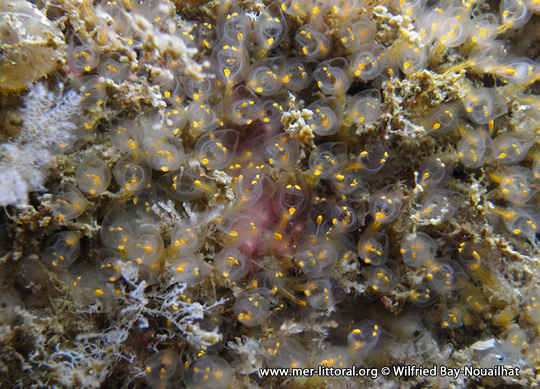
Ile de Groix, France, 10 meters, 2012, WBN
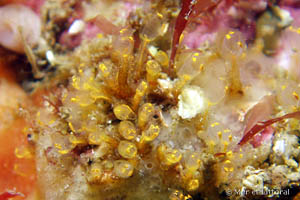
Pointe de Trévignon, France, 8 meters, 2008, WBN
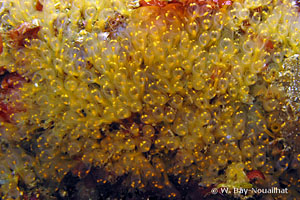
Camaret, France, 10 meters, 2008, WBN
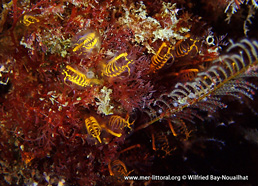
Illes Medes, Spain, 4 meters, 2018, WBN
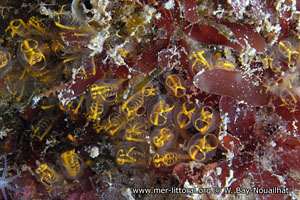
Illes Medes, Spain, 5 meters, 2009, WBN
Pycnoclavella aurilucens is a colonial ascidian. Each zooid is 6 mm in height and 2 mm in diameter. They are joined together by a thick basal stolon encrusting rocks and may form colonies up to 10 cm in diameter. Zooids arise from a short stalk erected from the basal crust. The test is transparent and three spots of various colour, orange, yellow or white can be seen on the upper part of the branchial sac. In winter, zooids disappear, and the basal stolon is the only remaining part of the colony. In Spring, zooids bud from the stolon. It lives attached to rocks or hydrarians from 5 to 25 meters deep in current-swept areas
Pycnoclavella aurilucens is found in the Atlantic Ocean, the English Channel and the Mediterranean Sea.
Source : World Register of Marine Species
Biota (Superdomain)
Animalia (Kingdom)
Chordata (Phylum)
Tunicata (Subphylum)
Ascidiacea (Class)
Aplousobranchia (Order)
Clavelinidae (Family)
Pycnoclavella (Genus)
Pycnoclavella aurilucens (Species)
Zooid : individual, single animal.
Stolon : root-like element binding together the individuals of a colony.
Test : or tunic: thick layer secreted by the mantel containing cellulose and protecting the animal.
Text : Anne Bay-Nouailhat © 2005 - 2026.
Photos : ©
Wilfried Bay-Nouailhat. Published with his kind permission.
Websites and reference works : Consult bibliography
Image satellite: © Esri, DigitalGlobe, GeoEye, Earthstar Geographics, CNES/Airbus DS, USDA, USGS, AeroGRID, IGN, and the GIS User Community.
Données de distribution : Pycnoclavella aurilucens Garstang, 1891 in GBIF Secretariat (2019). GBIF Backbone Taxonomy. Checklist dataset https://doi.org/10.15468/39omei accessed via GBIF.org on 2026-04-19.
Source : World Register of Marine Species
Biota (Superdomain)
Animalia (Kingdom)
Chordata (Phylum)
Tunicata (Subphylum)
Ascidiacea (Class)
Aplousobranchia (Order)
Clavelinidae (Family)
Pycnoclavella (Genus)
Pycnoclavella aurilucens (Species)
Zooid : individual, single animal.
Stolon : root-like element binding together the individuals of a colony.
Test : or tunic: thick layer secreted by the mantel containing cellulose and protecting the animal.
Text : Anne Bay-Nouailhat © 2005 - 2026.
Photos : ©
Wilfried Bay-Nouailhat. Published with his kind permission.
Websites and reference works : Consult bibliography
Bay-Nouailhat A., November 2005, Description of Pycnoclavella aurilucens, [On line] https://www.european-marine-life.org/32/pycnoclavella-aurilucens.php, consulted on 2026 April 19.
Author

Chargée d’études en environnement marin
Plongeuse professionnelle - Naturaliste
© Mer et littoral 2004-2026 - All rights reserved
The texts and images on this website are not free of rights and cannot be copied and/or used without the agreement of their respective authors.
 Print
Print Download