



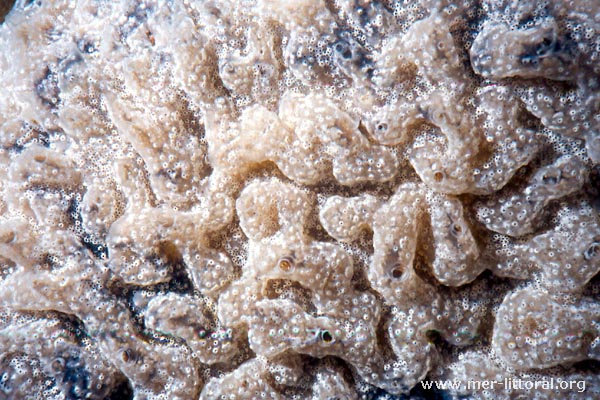
Glénan Archipelago, France, 5 meters, 2011, WBN
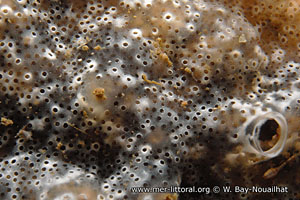
Glénan Archipelago, France, 6 meters, 2011, WBN
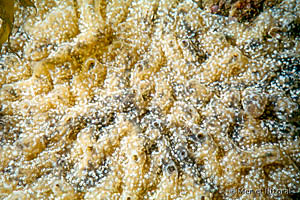
Glénan Archipelago, France, 6 meters, 2011, WBN
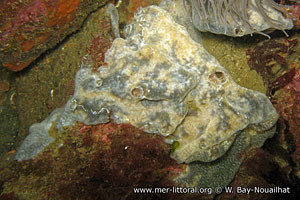
Camaret, France, 6 meters, 2011, WBN
Diplosoma spongiforme is an encrusting colonial ascidian which can cover rock surfaces of 20 to 30 cm in diameter. Several colonies can join together and can thus cover a surface of several square meters. Zooids are immersed in a common gelatinous test. Its thickness is irregular, up to 6 mm , giving to its surface an embossed aspect. The oral siphons of the zooids constitute tiny openings densely distributed all other the colony. Several zooids are gathered around a common, broad and slightly prominent atrial siphon, forming a system. Several systems occur in the colony making it resemble a sponge. The jelly-synascidian has a white translucent test with greenish or yellowish mottlings. The margin of the siphons may be white or bluish.
Diplosoma spongiforme is present from surface to 40 m deep in the Atlantic Ocean, the English channel, the North Sea and the Mediterranean Sea.
Source : World Register of Marine Species
Biota (Superdomain)
Animalia (Kingdom)
Chordata (Phylum)
Tunicata (Subphylum)
Ascidiacea (Class)
Aplousobranchia (Order)
Didemnidae (Family)
Diplosoma (Genus)
Diplosoma spongiforme (Species)
Zooid : individual, single animal.
Test : or tunic: thick layer secreted by the mantel containing cellulose and protecting the animal.
Oral siphon : opening by which water is drawn in the ascidian.
Atrial siphon : opening through which water is expelled.
Text : © 2005 - 2026.
Photos : ©
Wilfried Bay-Nouailhat. Published with his kind permission.
Websites and reference works : Consult bibliography
Image satellite: © Esri, DigitalGlobe, GeoEye, Earthstar Geographics, CNES/Airbus DS, USDA, USGS, AeroGRID, IGN, and the GIS User Community.
Données de distribution : Diplosoma spongiforme (Giard, 1872) in GBIF Secretariat (2019). GBIF Backbone Taxonomy. Checklist dataset https://doi.org/10.15468/39omei accessed via GBIF.org on 2026-04-19.
Source : World Register of Marine Species
Biota (Superdomain)
Animalia (Kingdom)
Chordata (Phylum)
Tunicata (Subphylum)
Ascidiacea (Class)
Aplousobranchia (Order)
Didemnidae (Family)
Diplosoma (Genus)
Diplosoma spongiforme (Species)
Zooid : individual, single animal.
Test : or tunic: thick layer secreted by the mantel containing cellulose and protecting the animal.
Oral siphon : opening by which water is drawn in the ascidian.
Atrial siphon : opening through which water is expelled.
Text : © 2005 - 2026.
Photos : ©
Wilfried Bay-Nouailhat. Published with his kind permission.
Websites and reference works : Consult bibliography
En cours de rédaction, November 2005, Description of Diplosoma spongiforme, [On line] https://www.european-marine-life.org/32/diplosoma-spongiforme.php, consulted on 2026 April 19.
Author

Association pour la découverte et la protection du milieu marin
© Mer et littoral 2004-2026 - All rights reserved
The texts and images on this website are not free of rights and cannot be copied and/or used without the agreement of their respective authors.
 Print
Print Download