



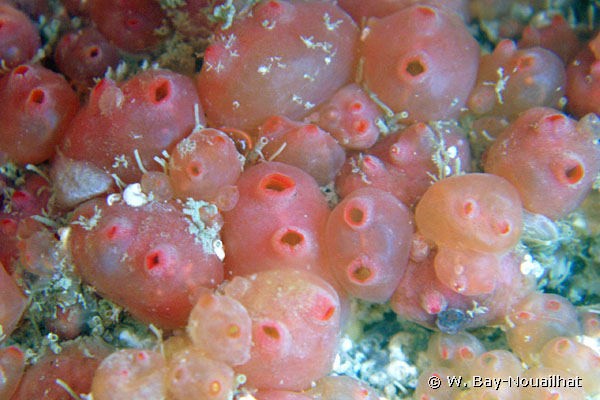
Concarneau Bay, France, 1 meter, 2011, WBN
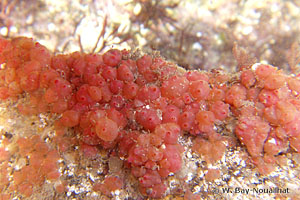
Concarneau Bay, France, 1 meter, 2011, WBN
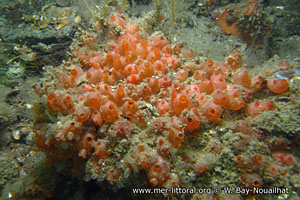
Rivière du Trieux, France, 12 metres, 2011, WBN
Dendrodoa grossularia is a solitary ascidian up to 2 cm long and about 1,5 cm in diameter. Its body has the form of a flat dome with an enlarging base but sometimes it can be erected and marble-shaped. The oral siphon is terminal, close to the atrial siphon and both are four-lobed. The test is reddish-brown. It can live solitary or in groups attached to rocks, shells or seaweeds.
Distomus variolosus develops flat and the individuals appear to be agglomerated with a common coat. Polycarpa scuba also has a shape of a tea-pot but the siphons are larger, more apart and of square section.
Dendrodoa grossularia is found from surface to 100 m deep in the Atlantic Ocean from the Arctic to the Southern coasts of Brittany, in the English Channel, the North Sea and West-Baltic.
Source : World Register of Marine Species
Biota (Superdomain)
Animalia (Kingdom)
Chordata (Phylum)
Tunicata (Subphylum)
Ascidiacea (Class)
Stolidobranchia (Order)
Styelidae (Family)
Dendrodoa (Genus)
Dendrodoa grossularia (Species)
Test : or tunic: thick layer secreted by the mantel containing cellulose and protecting the animal.
Oral siphon : opening by which water is drawn in the ascidian.
Atrial siphon : opening through which water is expelled.
Text : Anne Bay-Nouailhat © 2006 - 2026.
Photos : ©
Wilfried Bay-Nouailhat. Published with his kind permission.
Websites and reference works : Consult bibliography
Image satellite: © Esri, DigitalGlobe, GeoEye, Earthstar Geographics, CNES/Airbus DS, USDA, USGS, AeroGRID, IGN, and the GIS User Community.
Données de distribution : Dendrodoa grossularia (Van Beneden, 1846) in GBIF Secretariat (2019). GBIF Backbone Taxonomy. Checklist dataset https://doi.org/10.15468/39omei accessed via GBIF.org on 2026-06-13.
Source : World Register of Marine Species
Biota (Superdomain)
Animalia (Kingdom)
Chordata (Phylum)
Tunicata (Subphylum)
Ascidiacea (Class)
Stolidobranchia (Order)
Styelidae (Family)
Dendrodoa (Genus)
Dendrodoa grossularia (Species)
Test : or tunic: thick layer secreted by the mantel containing cellulose and protecting the animal.
Oral siphon : opening by which water is drawn in the ascidian.
Atrial siphon : opening through which water is expelled.
Text : Anne Bay-Nouailhat © 2006 - 2026.
Photos : ©
Wilfried Bay-Nouailhat. Published with his kind permission.
Websites and reference works : Consult bibliography
Bay-Nouailhat A., January 2006, Description of Dendrodoa grossularia, [On line] https://www.european-marine-life.org/32/dendrodoa-grossularia.php, consulted on 2026 June 13.
Author

Chargée d’études en environnement marin
Plongeuse professionnelle - Naturaliste
© Mer et littoral 2004-2026 - All rights reserved
The texts and images on this website are not free of rights and cannot be copied and/or used without the agreement of their respective authors.
 Print
Print Download