



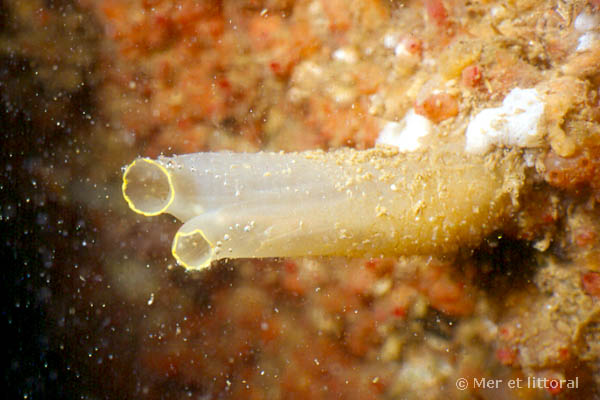
Concarneau Bay, France, 5 meters, 2011, WBN
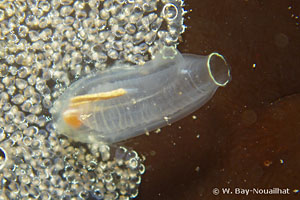
Concarneau Bay, France, 4 meters, 2011, WBN
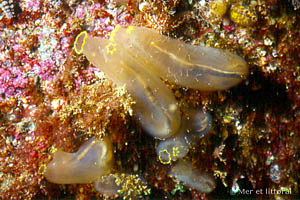
Concarneau Bay, France, 4 meters, 2011, WBN
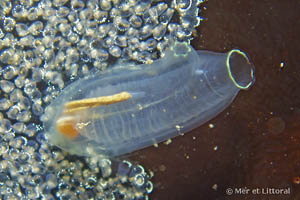
Concarneau Bay, France, 11 meters, 2011, WBN
Ciona intestinalis is a solitary ascidian which is up to 15 cm high. This upright cylindrical sea-squirt has a smooth soft test. It is translucent and its colour varies from white to yellow. Muscular bands, branchial sac and intestine are visible through the test. The edges of the siphons have a yellow margin. Oral and atrial siphons are contiguous and terminal. The oral siphon has 8 lobes and the atrial one has 6 lobes. Yellow sea-squirts often live in groups attached to rocks, piles, hulls. It can be common in harbours because this species seems to bear polluted waters.
Ciona intestinalis is found from low water level to 50 m deep in the Atlantic Ocean, the English Channel, the North Sea, the Baltic sea and the Mediterranean Sea.
Source : World Register of Marine Species
Dernière mise à jour 24-04-2024
Test : or tunic: thick layer secreted by the mantel containing cellulose and protecting the animal.
Oral siphon : opening by which water is drawn in the ascidian.
Atrial siphon : opening through which water is expelled.
Text : Anne Bay-Nouailhat © 2005 - 2024.
Photos : ©
Wilfried Bay-Nouailhat. Published with his kind permission.
Websites and reference works : Consult bibliography
Image satellite: © Esri, DigitalGlobe, GeoEye, Earthstar Geographics, CNES/Airbus DS, USDA, USGS, AeroGRID, IGN, and the GIS User Community.
Données de distribution : Ciona intestinalis in GBIF Secretariat (2019). GBIF Backbone Taxonomy. Checklist dataset https://doi.org/10.15468/39omei accessed via GBIF.org on 2024-04-24.
Test : or tunic: thick layer secreted by the mantel containing cellulose and protecting the animal.
Oral siphon : opening by which water is drawn in the ascidian.
Atrial siphon : opening through which water is expelled.
Text : Anne Bay-Nouailhat © 2005 - 2024.
Photos : ©
Wilfried Bay-Nouailhat. Published with his kind permission.
Websites and reference works : Consult bibliography
Bay-Nouailhat A., October 2005, Description of Ciona intestinalis, [On line] https://www.european-marine-life.org/32/ciona-intestinalis.php, consulted on 2024 April 24.
Author

Project manager in marine environment
Professional diver - Naturalist
© Mer et littoral 2004-2024 - All rights reserved
The texts and images on this website are not free of rights and cannot be copied and/or used without the agreement of their respective authors.
 Print
Print Download