



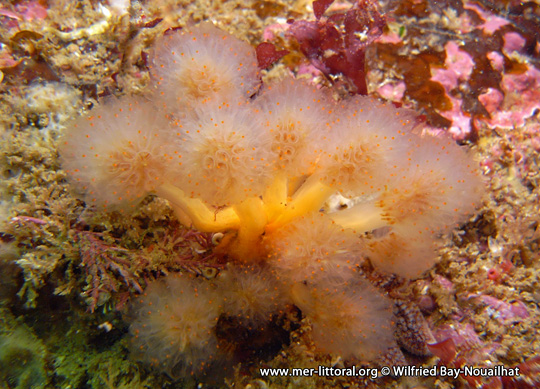
Pointe de Trévignon, France, 8 meters, 2014, WBN
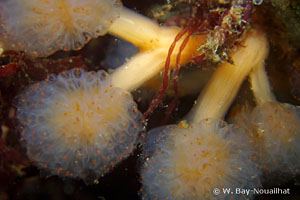
Glénan Archipelago, France, 7 meters, 2011, WBN
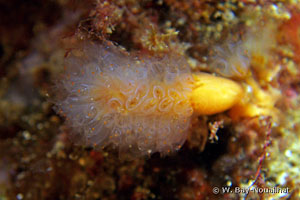
Glénan Archipelago, France, 8 meters, 2011, WBN
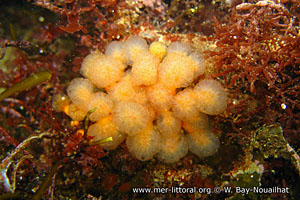
Concarneau Bay, France, 4 meters, 2011, WBN
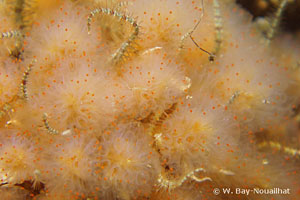
Ria d’Etel, France, 11 meters, 2011, WBN
Aplidium punctum is a colonial ascidian forming capitate colonies reaching 6 cm in height. Up to forty zooids are embedded in a common test forming a flat-topped lobe arising from a stalk. The base of the colony is often encrusted with sand. The test is transluscent and the general colour of the colony is pale orange. Each zooid has a six-lobed oral siphon and a red spot at the upper-end of the endostyle. Colonies of orange flake-ascidians often live aggregated, forming bunches attached to rocks from low water level to 25 meters deep.
Aplidium punctum is found in the North-East Atlantic and the English Channel.
Source : World Register of Marine Species
Dernière mise à jour 28-08-2025
Zooid : individual, single animal.
Test : or tunic: thick layer secreted by the mantel containing cellulose and protecting the animal.
Oral siphon : opening by which water is drawn in the ascidian.
Endostyle : groove through which food particles are moved up to the oesophagus.
Text : Anne Bay-Nouailhat © 2005 - 2025.
Photos : ©
Wilfried Bay-Nouailhat. Published with his kind permission.
Websites and reference works : Consult bibliography
Image satellite: © Esri, DigitalGlobe, GeoEye, Earthstar Geographics, CNES/Airbus DS, USDA, USGS, AeroGRID, IGN, and the GIS User Community.
Données de distribution : Aplidium punctum in GBIF Secretariat (2019). GBIF Backbone Taxonomy. Checklist dataset https://doi.org/10.15468/39omei accessed via GBIF.org on 2025-08-28.
Zooid : individual, single animal.
Test : or tunic: thick layer secreted by the mantel containing cellulose and protecting the animal.
Oral siphon : opening by which water is drawn in the ascidian.
Endostyle : groove through which food particles are moved up to the oesophagus.
Text : Anne Bay-Nouailhat © 2005 - 2025.
Photos : ©
Wilfried Bay-Nouailhat. Published with his kind permission.
Websites and reference works : Consult bibliography
Bay-Nouailhat A., March 2005, Description of Aplidium punctum, [On line] https://www.european-marine-life.org/32/aplidium-punctum.php, consulted on 2025 August 28.
Author

Project manager in marine environment
Professional diver - Naturalist
© Mer et littoral 2004-2025 - All rights reserved
The texts and images on this website are not free of rights and cannot be copied and/or used without the agreement of their respective authors.
 Print
Print Download