



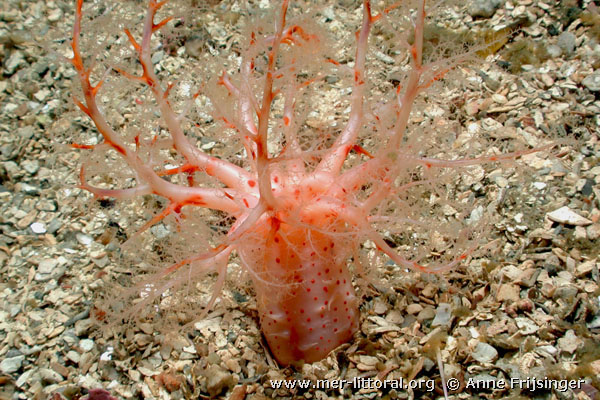
Lysefjord, Norway, 9 meters, AF
Psolus phantapus is a sea cucumber of up to 20 cm in length. Its cylindrical body erect at each ends in a U-shape, is partially buried in sand or mud among stony bottoms. The posterior side, at the end of which is the anus, is usually hidden under the substratum. The central part, which is also hidden, forms a rectangular sole, strenghten by spicules. Many tube feet concentrate there, a double row on each side and down the middle, so that the brown psolus may attached to stones. Its body is yellowish brown to dark brown and its thick skin is covered with numerous small scales. The only visible part is the anterior side with the introvert and the crown of 10 bushy tentacles that surounds the mouth. The tentacles are pinkish white with orange patches. They are covered with mucus on which micro-organisms stick ; then tentacles are one after the other put inside the mouth to collect food. The introvert is pinkish white with pink dots that extend toward the mouth. Its skin is smooth and it bears five rows of tube feet regularly spaced.
Psolus phantapus is found from 5 to 400 m deep in the Atlantic Ocean from the Celtic Sea (South Ireland) up to Norway, in the North Sea and up to the Arctic. In the North-West Atlantic, from Canada to Cape Cod, (North-East coasts of the USA).
Source : World Register of Marine Species
Biota (Superdomain)
Animalia (Kingdom)
Echinodermata (Phylum)
Echinozoa (Subphylum)
Holothuroidea (Class)
Actinopoda (Subclass)
Dendrochirotida (Order)
Psolidae (Family)
Psolus (Genus)
Psolus phantapus (Species)
Sole : base clinging to substratum.
Spicules : tiny calcareous element that stiffens the holothurian body.
Tube foot : tube-shaped element ending by a sucker-disc used to attach to subtratum or to bring food particles into the mouth.
Introvert : anterior part bearing the mouth and extensible and retractile inside the body.
Text : Anne Bay-Nouailhat © 2008 - 2026.
Photos : ©
Anne Frijsinger. Published with his kind permission.
Websites and reference works : Consult bibliography
Image satellite: © Esri, DigitalGlobe, GeoEye, Earthstar Geographics, CNES/Airbus DS, USDA, USGS, AeroGRID, IGN, and the GIS User Community.
Données de distribution : Psolus phantapus (Strussenfelt, 1765) in GBIF Secretariat (2019). GBIF Backbone Taxonomy. Checklist dataset https://doi.org/10.15468/39omei accessed via GBIF.org on 2026-04-17.
Source : World Register of Marine Species
Biota (Superdomain)
Animalia (Kingdom)
Echinodermata (Phylum)
Echinozoa (Subphylum)
Holothuroidea (Class)
Actinopoda (Subclass)
Dendrochirotida (Order)
Psolidae (Family)
Psolus (Genus)
Psolus phantapus (Species)
Sole : base clinging to substratum.
Spicules : tiny calcareous element that stiffens the holothurian body.
Tube foot : tube-shaped element ending by a sucker-disc used to attach to subtratum or to bring food particles into the mouth.
Introvert : anterior part bearing the mouth and extensible and retractile inside the body.
Text : Anne Bay-Nouailhat © 2008 - 2026.
Photos : ©
Anne Frijsinger. Published with his kind permission.
Websites and reference works : Consult bibliography
Bay-Nouailhat A., August 2008, Description of Psolus phantapus, [On line] https://www.european-marine-life.org/30/psolus-phantapus.php, consulted on 2026 April 17.
Author

Chargée d’études en environnement marin
Plongeuse professionnelle - Naturaliste
© Mer et littoral 2004-2026 - All rights reserved
The texts and images on this website are not free of rights and cannot be copied and/or used without the agreement of their respective authors.
 Print
Print Download