



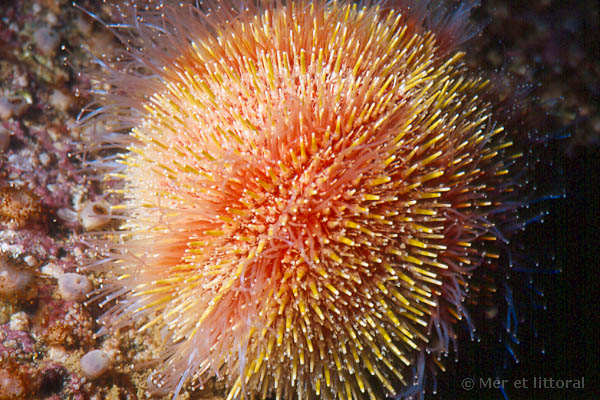
Concarneau Bay, France, 7 meters, 2005, WBN
Echinus esculentus is a globular sea urchin between 10 and 17 cm in diameter. Spines are short, around 1,5 cm long, thick and regular. Their colour is variable: greenish or pale purple. The thick test is purple and red with five clearer bands on the ambulacral plates. When extending, tube-feet are clearly visible among the spines. They are used to adhere to subtratum. The common sea urchin lives on rocks where it feeds on seaweeds, especially laminaria, or bryozoans or other small invertebrates.
Echinus esculentus is found from surface to 50 m deep, and sometimes at depths up to 1200m, in the Atlantic Ocean from Norway to Portugal, in the English Channel and the North sea.
Source : World Register of Marine Species
Biota (Superdomain)
Animalia (Kingdom)
Echinodermata (Phylum)
Echinozoa (Subphylum)
Echinoidea (Class)
Euechinoidea (Subclass)
Carinacea (Infraclass)
Echinacea (Subterclass)
Camarodonta (Order)
Echinidea (Infraorder)
Echinidae (Family)
Echinus (Genus)
Echinus esculentus (Species)
Test : rigid skeleton of sea urchins.
Ambulacral plates : Test plates pierced by numerous holes through which tube-feet can extend.
Tube foot : tube-shaped element ending by a sucker-disc used to attach to subtratum.
Text : Anne Bay-Nouailhat © 2005 - 2026.
Photos : ©
Wilfried Bay-Nouailhat. Published with his kind permission.
Websites and reference works : Consult bibliography
Image satellite: © Esri, DigitalGlobe, GeoEye, Earthstar Geographics, CNES/Airbus DS, USDA, USGS, AeroGRID, IGN, and the GIS User Community.
Données de distribution : Echinus esculentus Linnaeus, 1758 in GBIF Secretariat (2019). GBIF Backbone Taxonomy. Checklist dataset https://doi.org/10.15468/39omei accessed via GBIF.org on 2026-04-17.
Source : World Register of Marine Species
Biota (Superdomain)
Animalia (Kingdom)
Echinodermata (Phylum)
Echinozoa (Subphylum)
Echinoidea (Class)
Euechinoidea (Subclass)
Carinacea (Infraclass)
Echinacea (Subterclass)
Camarodonta (Order)
Echinidea (Infraorder)
Echinidae (Family)
Echinus (Genus)
Echinus esculentus (Species)
Test : rigid skeleton of sea urchins.
Ambulacral plates : Test plates pierced by numerous holes through which tube-feet can extend.
Tube foot : tube-shaped element ending by a sucker-disc used to attach to subtratum.
Text : Anne Bay-Nouailhat © 2005 - 2026.
Photos : ©
Wilfried Bay-Nouailhat. Published with his kind permission.
Websites and reference works : Consult bibliography
Bay-Nouailhat A., November 2005, Description of Echinus esculentus, [On line] https://www.european-marine-life.org/30/echinus-esculentus.php, consulted on 2026 April 17.
Author

Chargée d’études en environnement marin
Plongeuse professionnelle - Naturaliste
© Mer et littoral 2004-2026 - All rights reserved
The texts and images on this website are not free of rights and cannot be copied and/or used without the agreement of their respective authors.
 Print
Print Download