



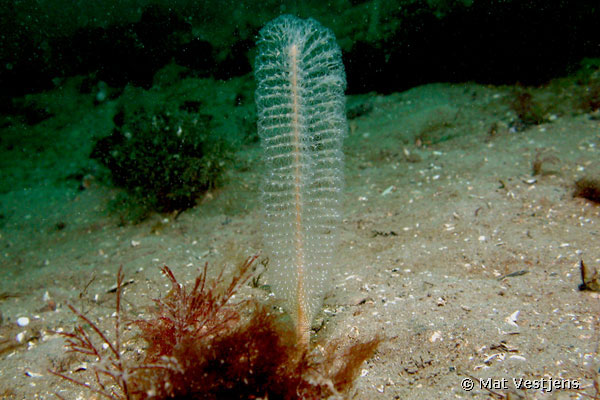
Oban, Scotland, 16 meters, 2008, MV
Virgularia mirabilis is a sea pen of up to 60 cm tall. Its leaf-like tiny branches tappering at the bottom and the top of the colony give it a delicate feather-shape. Generally, the internal calcareous axis is visible at the upper end of the sea pen. Embedded in mud, the long stalk reaches the half of the whole length of the colony. In the upper part, the rachis bears polyps in leaf-like series of 5 to 12 autozooids on each side of the straight central axis. Siphonozooids, in an oblique row at the base of each 'leaf', are not much visible. Colonies vary from white to yellow and can luminesce in darkness. When disturbed, colonies may quickly and entirely withdraw in the substratum.
Virgularia mirabilis is found in sheltered areas with soft bottoms such as fine sand or mud, from 10 meters down to 400 meters deep, in the North-East Atlantic Ocean, the English Channel, the North Sea and the Mediterranean Sea, and also in the North-West Altantic along the North-American coasts.
Source : World Register of Marine Species
Biota (Superdomain)
Animalia (Kingdom)
Cnidaria (Phylum)
Anthozoa (Subphylum)
Octocorallia (Class)
Scleralcyonacea (Order)
Pennatuloidea (Superfamily)
Virgulariidae (Family)
Virgularia (Genus)
Virgularia mirabilis (Species)
Colony : group of several individuals of the same species. There, the colony has several individuals, the polyps, but the whole colony is considered as the animal.
Rachis : upper part of the Pennatulacea bearing polyps.
Polyps : within these colonial animals, the polyp is the individual.
Autozooids : specialized polyps in charge of catching food.
Siphonozooids : specialized polyps without tentacles in charge of driving water into the colony.
Text : Wilfried Bay-Nouailhat © 2008 - 2026.
Photos : ©
Mat Vestjens. Published with his kind permission.
Websites and reference works : Consult bibliography
Image satellite: © Esri, DigitalGlobe, GeoEye, Earthstar Geographics, CNES/Airbus DS, USDA, USGS, AeroGRID, IGN, and the GIS User Community.
Données de distribution : Virgularia mirabilis (Müller, 1776) in GBIF Secretariat (2019). GBIF Backbone Taxonomy. Checklist dataset https://doi.org/10.15468/39omei accessed via GBIF.org on 2026-06-09.
Source : World Register of Marine Species
Biota (Superdomain)
Animalia (Kingdom)
Cnidaria (Phylum)
Anthozoa (Subphylum)
Octocorallia (Class)
Scleralcyonacea (Order)
Pennatuloidea (Superfamily)
Virgulariidae (Family)
Virgularia (Genus)
Virgularia mirabilis (Species)
Colony : group of several individuals of the same species. There, the colony has several individuals, the polyps, but the whole colony is considered as the animal.
Rachis : upper part of the Pennatulacea bearing polyps.
Polyps : within these colonial animals, the polyp is the individual.
Autozooids : specialized polyps in charge of catching food.
Siphonozooids : specialized polyps without tentacles in charge of driving water into the colony.
Text : Wilfried Bay-Nouailhat © 2008 - 2026.
Photos : ©
Mat Vestjens. Published with his kind permission.
Websites and reference works : Consult bibliography
Bay-Nouailhat W., August 2008, Description of Virgularia mirabilis, [On line] https://www.european-marine-life.org/05/virgularia-mirabilis.php, consulted on 2026 June 09.
Author

Plongeur - Naturaliste
Photographe Sous-Marin
© Mer et littoral 2004-2026 - All rights reserved
The texts and images on this website are not free of rights and cannot be copied and/or used without the agreement of their respective authors.
 Print
Print Download