



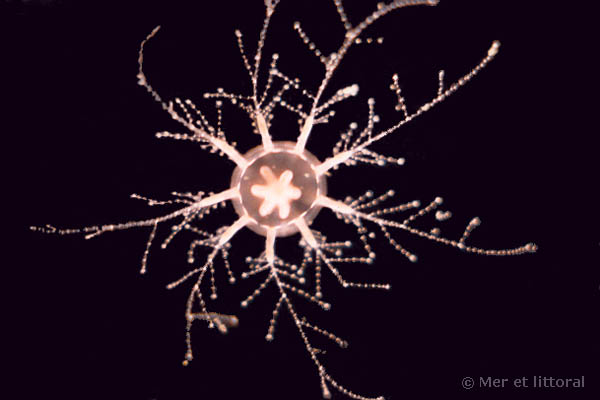
Laboratory, 2004, WBN
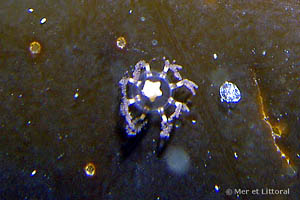
Concarneau Bay, France, 5 meters, 2004, WBN
Cladonema radiatum is a small anthomedusa whose dome-shaped umbrella reached 6 mm in diameter. The whitish manubrium which bears the gonads can be seen through the translucent umbrella. On the margin of the umbrella, there are generally eight elongated bulbs from where branched tentacules stretch out. Under each one of these bulbs, 1 to 4 stalked buttons are used to stick on the substratum. The root-arm medusa often settles on seaweeds and Zostera. Belonging to planktonic species, it has a hopping way of swimming, then it suddenly folds its tentacles and let itself fall. Present from June to October, it can be very abundant during warm periods and can cause tingling sensation to bathers. This little medusa is the sexual swimming form of a small hydroid living fixed to seaweeds, marine plants and rocks.
Cladonema radiatum is found in the North-Atlantic Ocean, the North Sea, the English Channel and the Mediterranean Sea. It is also listed in Japan.
Source : World Register of Marine Species
Biota (Superdomain)
Animalia (Kingdom)
Cnidaria (Phylum)
Medusozoa (Subphylum)
Hydrozoa (Class)
Hydroidolina (Subclass)
Anthoathecata (Order)
Capitata (Suborder)
Cladonematidae (Family)
Cladonema (Genus)
Cladonema radiatum (Species)
Anthomedusa : jellyfish belonging to the order Anthoathecatae. During their life cycle, they alternate a sessile polyp generation with a swimming medusa one.
Umbrella : external layer of the medusa generally bell-shaped.
Manubrium : tubular gastric cavity ended by the mouth.
Gonads : pouch containing sexual cells.
Substratum : surface where an organism lives in or on.
Plankton : free swimming animal or vegetal living in sea or fresh water.
Text : Wilfried Bay-Nouailhat © 2006 - 2026.
Photos : ©
Wilfried Bay-Nouailhat. Published with his kind permission.
Websites and reference works : Consult bibliography
Image satellite: © Esri, DigitalGlobe, GeoEye, Earthstar Geographics, CNES/Airbus DS, USDA, USGS, AeroGRID, IGN, and the GIS User Community.
Données de distribution : Cladonema radiatum Dujardin, 1843 in GBIF Secretariat (2019). GBIF Backbone Taxonomy. Checklist dataset https://doi.org/10.15468/39omei accessed via GBIF.org on 2026-06-05.
Source : World Register of Marine Species
Biota (Superdomain)
Animalia (Kingdom)
Cnidaria (Phylum)
Medusozoa (Subphylum)
Hydrozoa (Class)
Hydroidolina (Subclass)
Anthoathecata (Order)
Capitata (Suborder)
Cladonematidae (Family)
Cladonema (Genus)
Cladonema radiatum (Species)
Anthomedusa : jellyfish belonging to the order Anthoathecatae. During their life cycle, they alternate a sessile polyp generation with a swimming medusa one.
Umbrella : external layer of the medusa generally bell-shaped.
Manubrium : tubular gastric cavity ended by the mouth.
Gonads : pouch containing sexual cells.
Substratum : surface where an organism lives in or on.
Plankton : free swimming animal or vegetal living in sea or fresh water.
Text : Wilfried Bay-Nouailhat © 2006 - 2026.
Photos : ©
Wilfried Bay-Nouailhat. Published with his kind permission.
Websites and reference works : Consult bibliography
Bay-Nouailhat W., june 2006, Description of Cladonema radiatum, [On line] https://www.european-marine-life.org/05/cladonema-radiatum.php, consulted on 2026 June 05.
Author

Plongeur - Naturaliste
Photographe Sous-Marin
© Mer et littoral 2004-2026 - All rights reserved
The texts and images on this website are not free of rights and cannot be copied and/or used without the agreement of their respective authors.
 Print
Print Download