



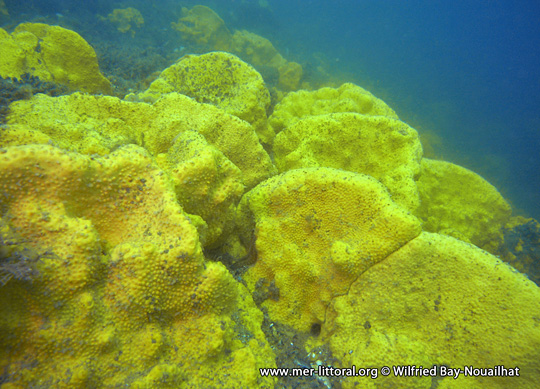
Ria d’Etel, France, 12 meters, 2012, WBN
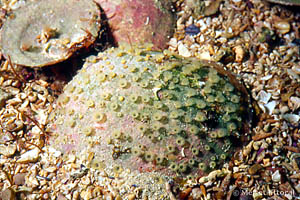
Glénan Archipelago, France, 14 meters, 2004, WBN
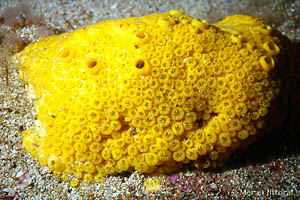
Glénan Archipelago, France, 14 meters, 2005, WBN
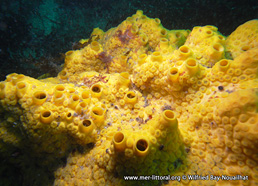
Ile de Groix, France, 10 meters, 2011, WBN
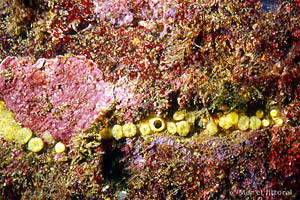
Glénan Archipelago, France, 14 meters, 2004, WBN
Cliona celata is a sponge presenting two morphological types more or less frequent whether this sponge lives in the Atlantic Ocean or whether it lives in the Mediterranean Sea. In the Atlantic, it mainly forms large and fleshy bright yellow masses, often isolated on poorly inhabited rocks. It may reach 60 cm in diameter which is the largest sponge from this area. Clearly visible inhaling pores cover the whole surface of the sponge. The oscules, at the end of small outgrowths, are arranged in somewhat linear systems, mainly on the upper part of the animal. In the Mediterranean Sea, Cliona celata is a perforating sponge. It lives inside shells or calcareous rocks which it perforates. Only the yellow ostioles and oscules are visible.
Cliona celata is found from surface to 200 m deep, in the Atlantic ocean, the English Channel, the North Sea, the Baltic Sea and the Mediterranean Sea.
Source : World Register of Marine Species
Biota (Superdomain)
Animalia (Kingdom)
Porifera (Phylum)
Demospongiae (Class)
Heteroscleromorpha (Subclass)
Clionaida (Order)
Clionaidae (Family)
Cliona (Genus)
Cliona celata (Species)
Oscule : Opening generally quite visible, through which sponges expel water they have filtered to extract food particles.
Ostioles : = = inhaling pore. Holes through which water enters into the sponge.
Text : Wilfried Bay-Nouailhat © 2004 - 2026.
Photos : ©
Wilfried Bay-Nouailhat. Published with his kind permission.
Websites and reference works : Consult bibliography
Image satellite: © Esri, DigitalGlobe, GeoEye, Earthstar Geographics, CNES/Airbus DS, USDA, USGS, AeroGRID, IGN, and the GIS User Community.
Données de distribution : Cliona celata Grant, 1826 in GBIF Secretariat (2019). GBIF Backbone Taxonomy. Checklist dataset https://doi.org/10.15468/39omei accessed via GBIF.org on 2026-06-11.
Source : World Register of Marine Species
Biota (Superdomain)
Animalia (Kingdom)
Porifera (Phylum)
Demospongiae (Class)
Heteroscleromorpha (Subclass)
Clionaida (Order)
Clionaidae (Family)
Cliona (Genus)
Cliona celata (Species)
Oscule : Opening generally quite visible, through which sponges expel water they have filtered to extract food particles.
Ostioles : = = inhaling pore. Holes through which water enters into the sponge.
Text : Wilfried Bay-Nouailhat © 2004 - 2026.
Photos : ©
Wilfried Bay-Nouailhat. Published with his kind permission.
Websites and reference works : Consult bibliography
Bay-Nouailhat W., april 2004, Description of Cliona celata, [On line] https://www.european-marine-life.org/02/cliona-celata.php, consulted on 2026 June 11.
Author

Plongeur - Naturaliste
Photographe Sous-Marin
© Mer et littoral 2004-2026 - All rights reserved
The texts and images on this website are not free of rights and cannot be copied and/or used without the agreement of their respective authors.
 Print
Print Download